


Programme – International Conference on Doping and Public Health
The International Conference on Doping and Public Health 2026 brings together researchers, practitioners, policymakers and prevention experts from across Europe and beyond to explore current challenges and trends related to performance and image-enhancing drugs (PIEDs). The programme features five thematic sessions covering global perspectives on doping and public health, prevention in fitness and gym environments, youth-focused interventions, substance-related harms, and treatment and recovery pathways. The programme will be updated as it develops, so please follow this page and our social media channels for the latest updates.
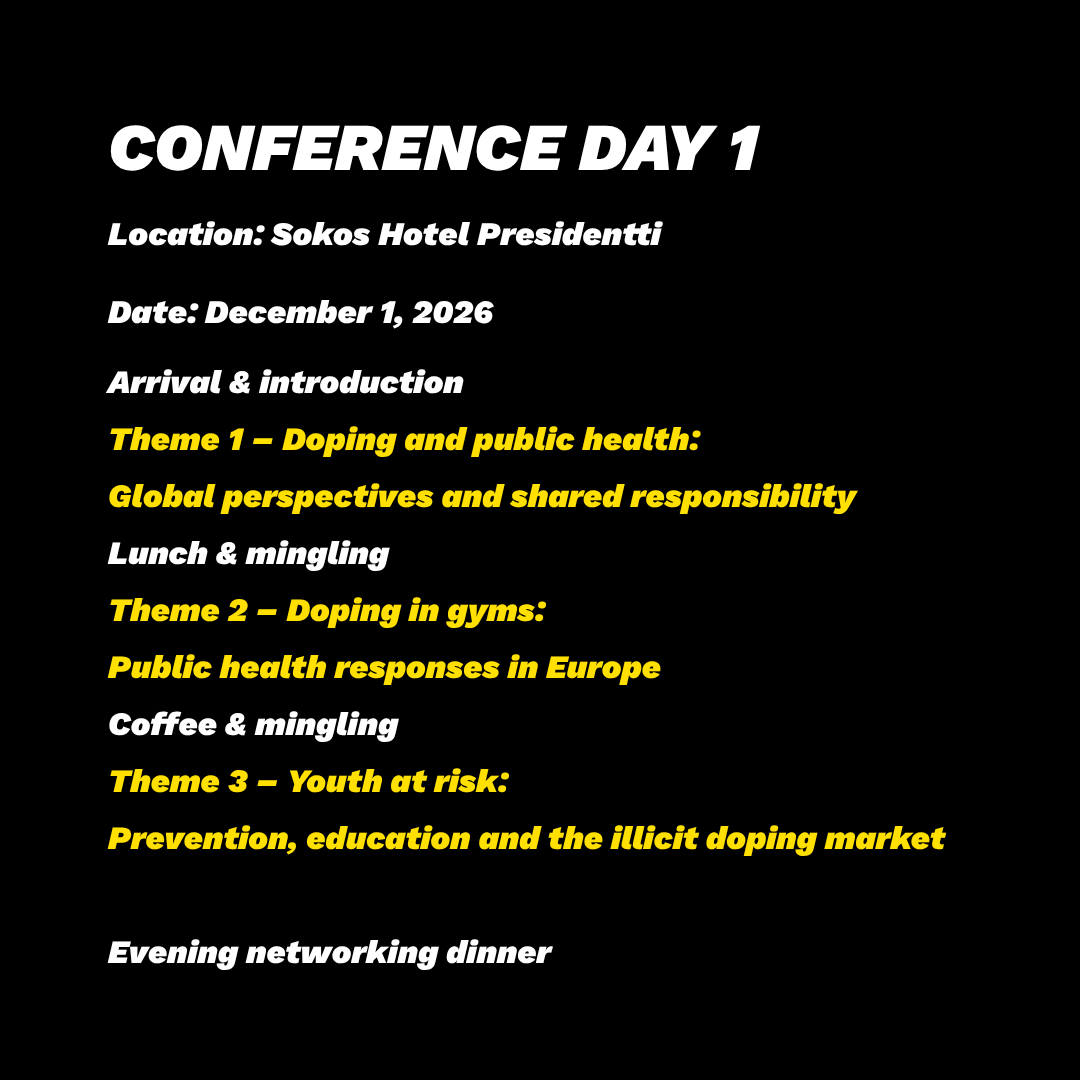
Conference Day 1
Date: December 1, 2026 | 9:00 – 16:30, 19:00-23:00
Arrival and introduction
- Registration & coffee
- Welcome
- Opening of the conference
- Practical info
Keynotes and Theme 1 – Doping and public health: Global perspectives and shared responsibility
- Anti-Doping in Recreational Sports: State of the Field – Fredrik Lauritzen (Anti-Doping Norway)
- Injectable Peptides: An emerging public health crisis? – Tim Piatkowski (The University of Queensland)
Lunch & mingling
Theme 2 – Doping in gyms: Public health responses in Europe
- Anti-Doping model for fitness centres and the Friend in the Mirror project among 10–12-year-olds in primary schools and sports clubs – Kasper Skat Lundgaard Krøll (Anti Doping Danmark)
- The Clean Exercise Commitment and Ambassadors’ Doping Prevention Classes Among Middle and Upper Secondary School Students – Mikko Lemettilä (A-Clinic Foundation)
- Clean Fitness Centers in Norway: From policy to practice — Prevention, Detection and Management in Gyms – Kristoffer Lie Loftheim (Anti Doping Norway)
- 100% Pure Hard Training – A co-produced model for successful doping prevention in Sweden – Johanna Gripenberg & Tobias Elgan (Karolinska Institutet/ STAD)
Coffee & mingling
Theme 3 – Youth at risk: Prevention, education and the illicit doping market
- From Pressure to Prevention: Confronting the Modern Drivers of Performance-Enhancing Substance Use through Education and Empowerment – Brian Parker (Taylor Hooton Foundation)
- From Prohibition to Harm Reduction: Rethinking Doping Prevention in Recreational Fitness – Eric Van Breda (Dopingautoriteit)
- Tuomas Korhonen (Finnish Customs)
- The Evolving Landscape of Image and Performance-Enhancing Drugs (IPEDs) in Recreational Sport and Exercise – Lambros Lazuras (University of Lincoln)
Evening networking dinner
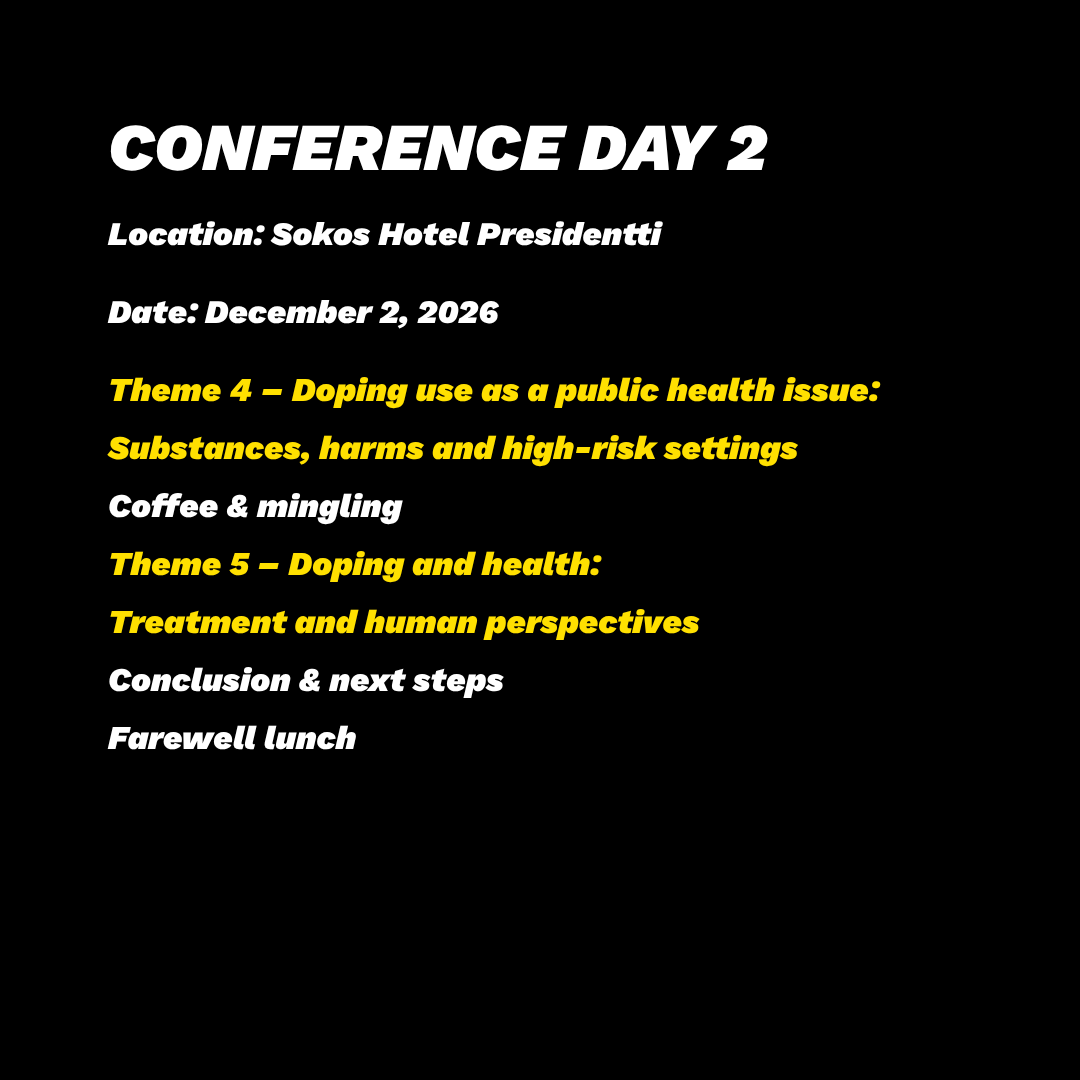
Conference Day 2
Date: December 2, 2026 | 9:00 – 12:30
Theme 4 – Doping use as a public health issue: Substances, harms and high-risk settings
- The Future of Human Enhancement in the Post-Doping Era – Tim Piatkowski (The University of Queensland)
- Long-term health consequences of anabolic-androgenic steroid use: New insights from the AAS LONG study – Astrid Björnebekk (Oslo University Hospital)
- Hidden use and visible health risks? Doping substance use and physical health among Finnish prisoners – Jukka Koskelo (A-Clinic Foundation)
Coffee & mingling
Theme 5 – Doping and health: Treatment and human perspectives
- Specialized outpatient clinic for (former) steroid users – Pim de Ronde (Spaarne Gasthuis)
- Recreational doping in Finland: insights from forensic autopsy studies – Paula Vauhkonen (Finnish Institute for Health and Welfare (THL) & Department of Forensic Medicine, University of Helsinki)
- TBD – Ingrid Havnes (Oslo University Hospital)
- Q&A with a former bodybuilder – Tapani Valkonen